Context & Problem
Real estate brokerages in the US spend heavily on paid lead channels — Zillow Premier Agent, Facebook/Instagram Ads, Google — yet systematically lose these leads due to slow or absent follow-up.
| Industry Data Point | Value |
|---|---|
| Lead contacted in < 5 min | 100× more likely to qualify |
| After 60 min wait | 10× drop in connection probability |
| US industry average callback time | 15 hours |
| Typical commission per transaction | ~$10,000 |
| Miss 5 qualified leads/month | $50,000/month in lost revenue |
Hypothesis: An AI voice agent that calls within 60 seconds of inquiry, qualifies the lead, and schedules a handoff call will be a solution brokerages pay for on retainer.
Experiment 1 — Speed-to-Lead Audit
I submitted real buyer inquiry forms on Zillow for 30 highly qualified Florida brokerages across 3 time windows, posing as a high-intent buyer — pre-approved, $450K–$550K budget, relocating from New York, ready in 60–90 days.
| Response Window | Brokerages | Count | % of 30 |
|---|---|---|---|
| < 5 minutes | 3 Tier A brokerages — same-day inbound routing | 3 | 10% |
| 5 – 30 minutes | 1 Tier A brokerage — agent on duty | 1 | 3% |
| 30 min – 2 hours | 2 Tier A/B brokerages — delayed agent callback | 2 | 7% |
| 2 – 24 hours | 2 Tier B brokerages — 15.5h and 23.5h response times | 2 | 7% |
| > 24 hours | 2 Tier B brokerages — 48h and 3-day response times | 2 | 7% |
| No response | 20 brokerages — incl. all 5 weekend inquiries | 20 | 67% |
Response rate by inquiry time window
Response time distribution — 30 inquiries sent
Weekend = Dead Zone. 7 buyer inquiries sent on Saturday. 0 responses. These are Tier A/A+ teams with active Zillow Premier Agent subscriptions — paying per lead, answering none.
Experiment 2 — ICP Pain Validation
Cold emails to two cohorts referencing the speed-to-lead problem. Measuring response rate, signal quality, and buying intent.
| Metric | Cohort 1 — Solo Realtors | Cohort 2 — Broker Owners |
|---|---|---|
| Emails sent | 200 | 173 |
| Response rate | 2.5% (5 of 200) | 3.5% (6 of 173) |
| High-signal responses | 1 of 5 (20%) | 4 of 6 (67%) |
| Opt-out / hostile | 3 of 5 (60%) | 1 of 6 (17%) |
| Buying signals (demo) | 0 | 2 — unsolicited |
| High-signal rate vs sent | 0.5% | 2.3% (4.6× higher) |
"We try to respond fast but honestly it depends on the agent. Some leads slip through."
Owns the structural problem. Agent dependency = systemic, not personal. Direct ICP signal.
"What exactly does your AI agent do with the lead? Does it call immediately?"
Specific product question — already evaluating fit. Warm lead.
"We actually struggle with this. Happy to take a look if you want to show what you built."
Unsolicited demo invitation. Highest-value response in the dataset.
"We already have an ISA team handling inbound."
Not a rejection — an opening. ISA teams don't cover nights, weekends, or national holidays. AI fills the gap they can't.
Verdict: Broker Owners are the ICP. Cohort 2 produced 4.6× more high-signal responses per email sent, 2 unsolicited demo requests, and only 1 opt-out vs 3 from Cohort 1. Solo realtors see the problem as personal — and get defensive. Broker owners see it as systemic — and want a fix.
Product Decisions Driven by Research
| Signal Observed | Product Decision | Rationale |
|---|---|---|
| 0% weekend response rate | AI agent runs 24/7/365 by default | Biggest pain window is off-hours and weekends |
| Broker cites agent dependency | Report per agent, not just per brokerage | Broker needs visibility into which agents are the bottleneck |
| ISA team objection | Position as ISA complement, not replacement | Removing ISA is too threatening — filling gaps is the easier sell |
| Solo realtors reacted defensively | De-prioritise Cohort 1 | Wrong segment — different product angle needed |
| 3 fast responders had no off-hours coverage | Lead with after-hours gap in outreach | Even self-perceived responsive teams have the weekend gap |
Solution Architecture
Product Goal
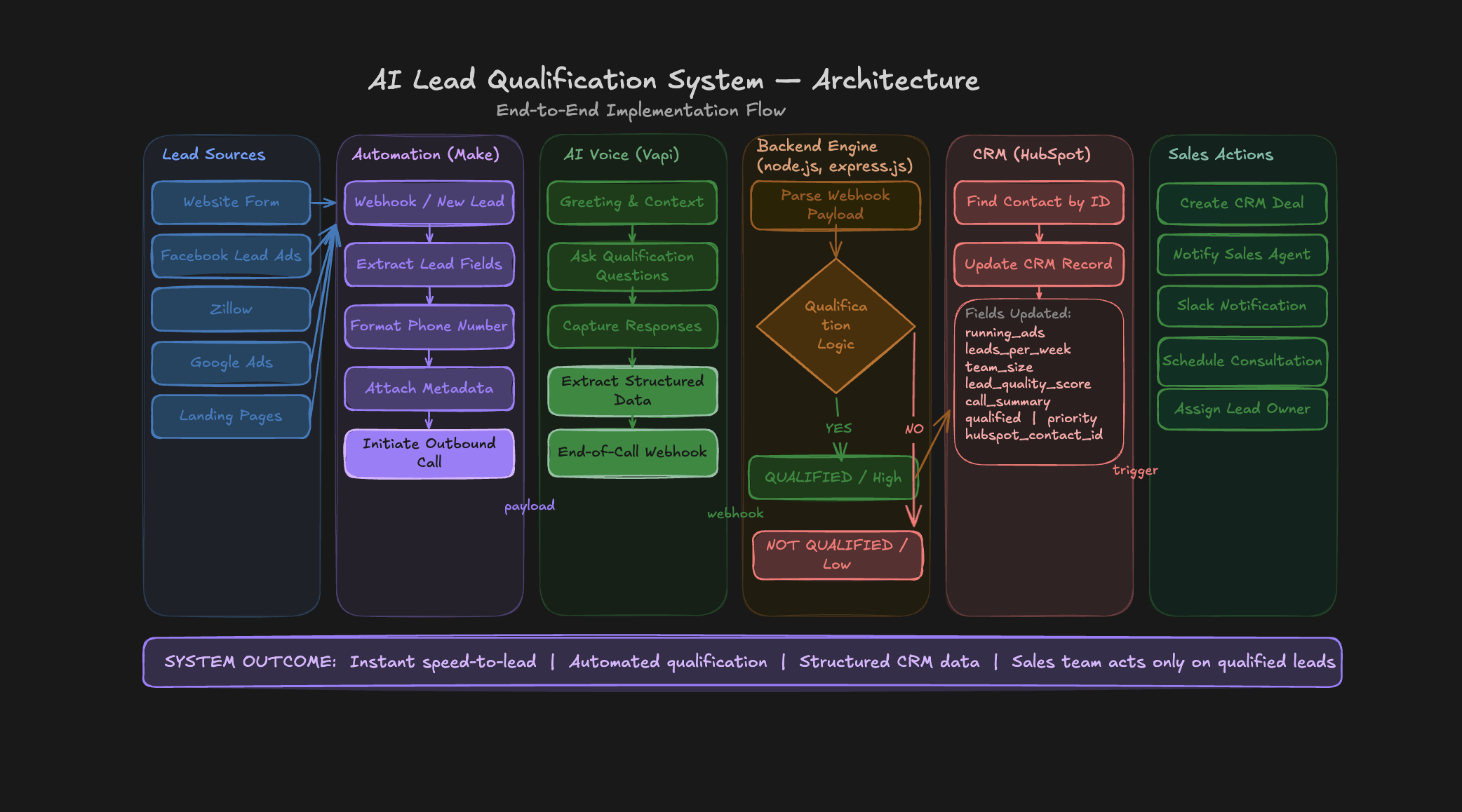
| Layer | Detail |
|---|---|
| Lead sources | Zillow, Facebook Ads, Google Ads, website forms, landing pages |
| Automation layer | Make (formerly Integromat) — webhook trigger, field extraction, phone formatting, metadata attachment, outbound call initiation |
| AI voice layer | Vapi — greeting, qualification questions, response capture, structured data extraction, end-of-call webhook |
| Backend | Node.js + Express — qualification logic, CRM update trigger |
| CRM | HubSpot — contact lookup, record update (lead quality score, call summary, agent assignment, priority flag) |
| Sales actions | Slack notification to agent, CRM deal creation, consultation scheduling |
System outcome: Instant speed-to-lead (< 60 seconds) · Automated qualification · Structured CRM data · Human agents act only on qualified leads
What I Learned as a PM
Framing matters as much as the solution.
Different segments require different problem framing — the same pain sounds personal to a solo realtor and systemic to a broker owner.
Experiment before building.
Both experiments ran before a single line of product code was written — architecture followed validation, not assumptions.
Objections are product signals.
The ISA team objection revealed the exact positioning that made the product non-threatening — complement, not replace.
Quantify the problem, don't describe it.
"67% of 30 Tier A brokerages didn't respond" is a proof point. "Brokerages miss leads" is just a claim.